
Author_Min Hye Yoon

The origin of creativity has been considered as a mystery, unknown source or as a talent that someone already is born with. Accordingly, there has been so much focus on the big C (big creativity), the aim of which is to nourish creative professionalism for a great writer, a scientist, visual and musical artists, etc. However, the presence of creativity can be seen easily in our daily lives from cooking and gardening to daily problem-solving and conversations with great sense of humors, which refers to as little C (little creativity) (Craft, 2001).
In this perspective, the definition of creativity embraces two qualities: originality and effectiveness (Runco and Jaeger, 2012). Originality is related to novelty and greatness of fresh insights. Not only originality, but effectiveness also will be required to make the concept of creativity complete, which is about usefulness and appropriateness for the novel idea that can be applied in the real situation.
In both perspectives on big and little C, creativity refers to not only a A-ha! moment but also it is about the process how it can be developed through. This is because many researchers assume that those ‘A-ha moments’ would be drawn from thinking process yielded through complex brain function.
- ‘A-ha moment’ through incubation period of time.
Among other suggestions in creative process, Wallas (1926) identified creative process as four steps, 1) preparation 2) incubation 3) illumination 4) revision. Those A-ha moments described here as illumination, which seems like a magical moment, however it might have been resulted through idea preparation and incubation period. After accumulating and analysing sources, the stage of illumination will happen which is to flash new insights and ideas. This incubation period of time may take from few hours to few months depending on how complex your ideas are to solve the issue. And revision on the creative ideas will be required to verify the idea to sort out the best potential solution in the real world context.
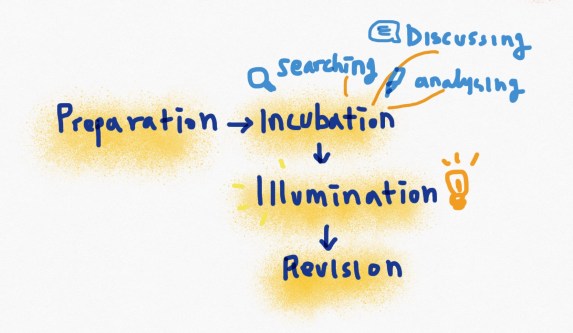
- Creative idea from problem solving.
Another noticeable introduction on creative process is identified by Torrance (1993). Torrance (1993) described this creative process as sensing a gap on missing information by asking questions, exploring, making hypothesis and testing the hypothesis. Individuals will identify problems when they sense the gab on some issues. Then they will ask questions and explore possible solutions in order to suggest the best promising idea. They will hypothesize their assumptions and test their hypothesis for verification of the idea.

- Creativity as the capacity of thinking by analogy for creating new relations.
Spearman(1930) described creative thinking as the process of making relations between different concepts in which both conscious and subconscious processes are operated. Ribot(1906) mentioned that creative thinking process will be through the capacity of thinking by “analogy”, the process of which will produce unpredicted and novel integration.
Those creative thinking processes will be required in order to produce unique, original yet useful outcomes as well as to support raising of creative persons for the future. Creativity will be the quality that need to be highlighted in future human endeavors, which is crucial to face uncertainty and ambiguity in the future.
Reference
Craft, A. (2001). Little c creativity. Creativity in education, 45.
Ribot, T. (1906). Essays on the creative imagination. London: Routledge & Kegan Paul.
Runco, M. A., & Jaeger, G. J. (2012). The standard definition of creativity. Creativity Research Journal, 24(1), 92-96.
Spearman, C. E. (1930). Creativemind London: Cambridge University Press.
Torrance, E. P. (1993). Understanding creativity: Where to start?. Psychological Inquiry, 4(3), 232-234.
Wallas, G. (1926). The art of thought.

 Min Hye-Yoon, 민혜윤