
If you are working in New Design Product (NDP) process field, setting up design and business strategies through understanding target user’s needs and motivations is crucial to product innovation and its success.
In the process of defining your business objectives for the NDP, you might set your assumptions and hypothesis about problems that are found from the existing products or systems. Thus, this might drive you to go in a certain direction, instead of thinking ahead of solutions, considering who target audiences will be, and what the target audiences’ needs and motivations will be. In addition to defining the target audience, it is essential to define major problems in order to tackle their core needs and solve problems.
However, how do we know their real needs and motivations?
How do we define their core problems?
Let’s suppose that you are developing a product for the elderly aged 65 years old and above. Which of the elderly group will you approach that will help you understand the elderly’s motivations and needs?
In the beginning, we can think of people around us such as our parents, grandparents, or the elderly living next door. We can still understand general difficulties and needs that might arise from those groups. Or we can conduct desktop research, searching population stats, reading recent news about the elderly, trends and places where the elderly people will be captured dominantly. These activities are meaningful UX research activities in order to understand your target user groups.
In other words, in order to identify target users and customers’ need and motivations, we usually look at the mainstreams that populated in the middle of the bell curve, those who are most ordinary group of people in your target user group population in your hypothesis.
However, sometimes all those meaningful activities would not be addressed enough to draw out what are their needs and motivations in a persuasive manner. The needs they are explaining are often not clear and obscure to find a meaningful insight. They might sense that something is lacking in current systems and products, but they would not know how to be better or improve the current situations. Or what they see is too obvious and linear to draw some deeper level of insights that is essential to product innovations.
In this case, we can stretch our user groups in a wider range by looking at the extremes than those in the mainstreams. The extremes mean a group of people placed at the end of two tails of the bell curve of the population distribution. It depends on your hypothesis and controls how you define the bell curve, but in general those are the minority group of people that behave and live in a different mindset and life setting, compared to the people in the mainstream.
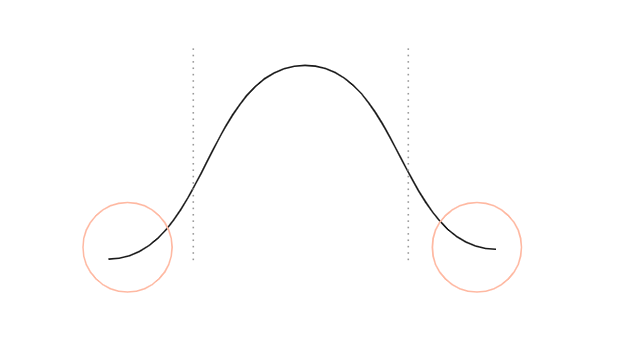
For example, let’s suppose that you are designing for a product as a platform where the elderly can socialise each other and learn a new activity together. One tail of the extreme in this case will be those are very active in social media in Youtube or Facebook. Probably they are highly empowered to run a youtube channel and actively share their fun experiences to others. Another tail in the extremes will be opposite, for those who will be isolated and novice in utilising all social media channels. In contrast to the elderly running Youtube channels, they may want to socialise in a different manner and they may prefer meeting in a small group in person.
They are the people who have a stronger desire, need and motivation than those in the middle and their behaviours and stories are unique compared to the mainstreams. In this way, your findings in users’ desires, motivations, and needs are amplified more than those in the middle and they will be the people who know the reasons why they specify those needs. Sometimes, the needs and motivations addressed by the extremes are the needs and motivations for the mainstreams as well.
Another benefit to understand the extremes is to satisfy a wider range for groups of people. As you embrace those extremes, your product will highly be accessible to more people, even in the minor groups populated at the tails.
Here are several tips on how to identify groups of people in the extremes:
#1 When you define those extremes, be aware to focus on behaviours, living patterns and personal characteristics of the demographics, rather than focusing on general demographic information itself such as age, living place, educational level, etc.
#2 Considering two tails of the extremes, which explain two opposite characters/ behaviours of one another. For example, if one is an expert group of people, another should be a novice group of people.
#3 Describing how their behaviour patterns will be like and what are their needs and motivations will be.
Your target users will not be defined by demographical characteristics such as how old they are, where they live in, and what they do, rather defined by their specific behaviours and unique life patterns.
Author_ UX researcher and designer, Hye Yoon Min.
References
https://designthinking.ideo.com/resources/extremes-and-mainstreams-design-toolkit-by-ideo-org

 Min Hye-Yoon, 민혜윤