
Design has been playing its role as a catalyst to foster innovation in product and development processes. Especially designers’ ways of thinking and working bring the use of term, “design thinking”, the process of which suggested as inspiration – ideate – prototype – implement, where nowadays any business can benefit from the process of design thinking to innovate their products and services.
Although this design thinking has studied from international groups of researchers (Cross, Dorst & Roozenburg, 1992) since early 1990’s, it is only recently that the concept has begun to gain spotlight to be actively implemented into business innovations.
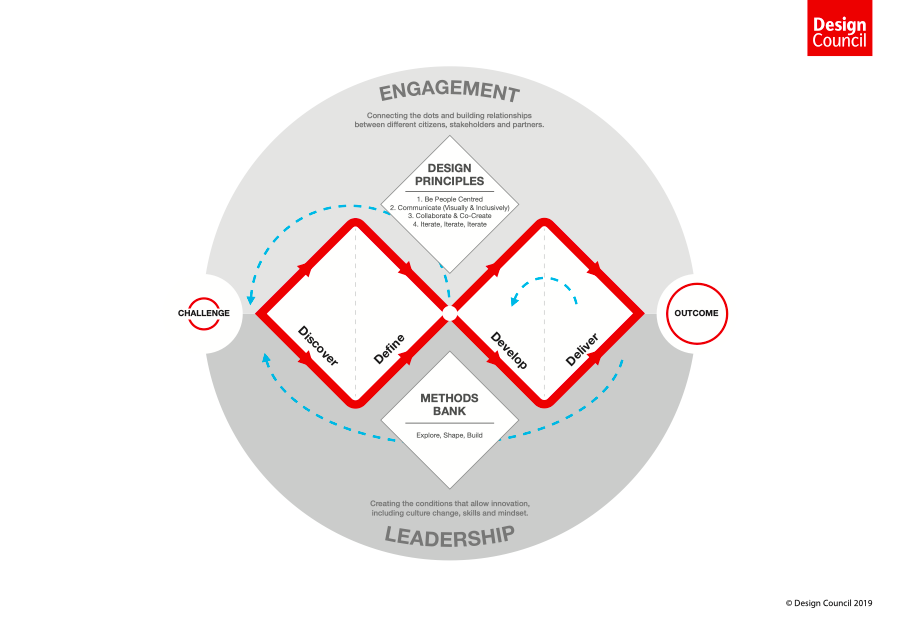
Some of the best known models are:
1) The HCD model (http://www.ideo.com/work/human-centered-design-toolkit)
2) The Double Diamond model, the British Design Council (http://www.designcouncil.org.uk)
3) The Design Thinking model, the Hasso-PlattnerInstitute (http://www.hpi.uni-potsdam.de/d_school/designthinking)
Due to its’ emphasis on design thinking as a cognitive process, it offers potential to stretch its chances to a tool for problem solving and innovating businesses, going beyond design development process tools.
This is to look at current business challenges with lenses of creative eyes, to extend business prospects with less judgmental attitudes, but with systemic ways and process to identify problems, brainstorm and ideate new possibilities, and narrowing down to the right solutions for challenges that your business face.
Having defined its cognitive characteristics of design thinking from prior researchers, this design thinking is differentiated from other scientific methods is due to its “abductive” way of reasoning and thinking by asking questions in design challenges such as “How might we…” Or “What if…” This is different from scientific ways of reasoning such as deduction or induction, looking at associations between variables – causality and correlation.
One of the representative reasonings is “How might we…” (HMW) statement. The main purpose of having this question is not to validate the current existing hypothesis, rather it is to define the core problems that we like to focus on as well as to explore and inspire a new possible solutions in seeking innovative ways, that might not exist so far.
For example, we want to solve problems that occur while commuting everyday as observation shows that commuting experiences affect our next activities that are scheduled after the commute.
Based on observations or data we have, we can craft a HMW question such as:
- How Might We help the ways of commuters go to work to be pleasant and enjoyable?
- How Might We help the ways of commuters go back home to be more restful and comfortable?
Through crafting several HMW statements, it helps team to clearly define what problems to tackle, but the statement inspires team to ideate and explore ideas to solve problems in innovative ways.
Overall, the real practice in design thinking facilitation will not happen in a linear process, rather it requires a lot of re-iterating the steps by re-visiting again the previous stage. This is because the product developmental processes tends to re-evolve in context of an ever-changing technology.
Thus, it would be beneficial to be ready to re-test any parts of the process with help with design thinking approach and its improvisational attitude.
How can we practice design thinking approach:
- Wondering and observing: Avoid having immediate perception and quick interpretation of a situation
- Abductive and inventive: Avoid looking for correct answers, and lead the process by organizing and planning
- Being visual, use of prototyping tools: Avoid always being in verbal, uses of analytical tools
- Being collaborative: avoid solving problems individually, instead invite stakeholders to solve problems together at the early stage.
References
- BROWN, Tim (2009). Change by Design. How Design Thinking transforms Organizations and inspires Innovation. New York: Harper Collins Publishers.
- CROSS, Nigel, DORST, Kees, ROOZENBURG, Norbert (Eds.) (1992). Research in Design Thinking. Delft: Delft University Press.
- MARTIN, Roger (2009). The Design of Business. Why Design Thinking is the next Competitive Advantage. Boston, Massachusetts: Harvard Business Press.
Author_ Hye Yoon, Min

 Min Hye-Yoon, 민혜윤