
How Might We Motivate Current/ Future Customers of Learning Platform ‘H’ to Stay Engaged?
- Customer Interview via Zoom
- Interview duration: 60 mins
- Interview participants: 10 pax Enterprise
- customer profiles – 6 pax
- Individual customer profiles – 4 pax
Background
Learning Platform ‘H’, originally founded in Singapore, offers a competitive suite of features tailored for tuition centres to help educators reduce administrative workload (AI generated worksheets) and support students’ personalised learning, while offering parents real-time visibility (E-assessment) into their child’s progress
As the platform expands its presence across Southeast Asia—including Thailand, Indonesia, Vietnam, the Philippines, and beyond—it aims to:
- Clearly define its unique value proposition in diverse local markets
- Identify areas for improvement within the current platform experience
- Uncover new business opportunities for service expansion in the region
so that 1) they can effectively motivate current customers to stay engaged with the current platform and 2) they can expand their business with new opportunities, knowing their strengths and weaknesses, and threats in the digital learning.
Note: For confidentiality purposes, the client’s name has been anonymised in this article and will be referred to as “Learning Platform H.”
☝️Users vs. Customers in an EdTech Context
In product development terminology, a user is someone who actually uses or interacts with a product, whereas a customer is someone who purchases or pays for it (linkedin.com). In many cases (especially in consumer apps), the user and customer might be the same person – for example, a learner who subscribes to an online course is both using the platform and paying for it. However, in the context of educational technology (EdTech) platforms, users and customers often diverge:
Institutional EdTech (B2B): The end-users are typically students or teachers who use the learning platform in the classroom or daily workflow, but the customers are the institutions or decision-makers (schools, districts, universities) that purchase and implement the product (medium.com). For instance, a school might buy an e-learning software license for all its students; the students and teachers use it (users), while the school administration is the paying customer. In an edtech context, individual tutors could belong to customers’ profile since they might run their own tutoring business although the business size might be small compared to institutional level.
Consumer EdTech (B2C): The end-user (learner) or their guardian is also the paying customer. For example, a parent might purchase a subscription to a language learning app for their child – here the child is the user and the parent is often the customer (in this case, the customer isn’t using the product directly, but is the one paying for it) (medium.com). In other direct-to-consumer scenarios (like an adult subscribing to an online course for themselves), the learner is both user and customer.
Note: This project case is more relevant to B2B cases than B2C.
👩🏻🧔🏻♂️ Representative Personas — Evelyn and David
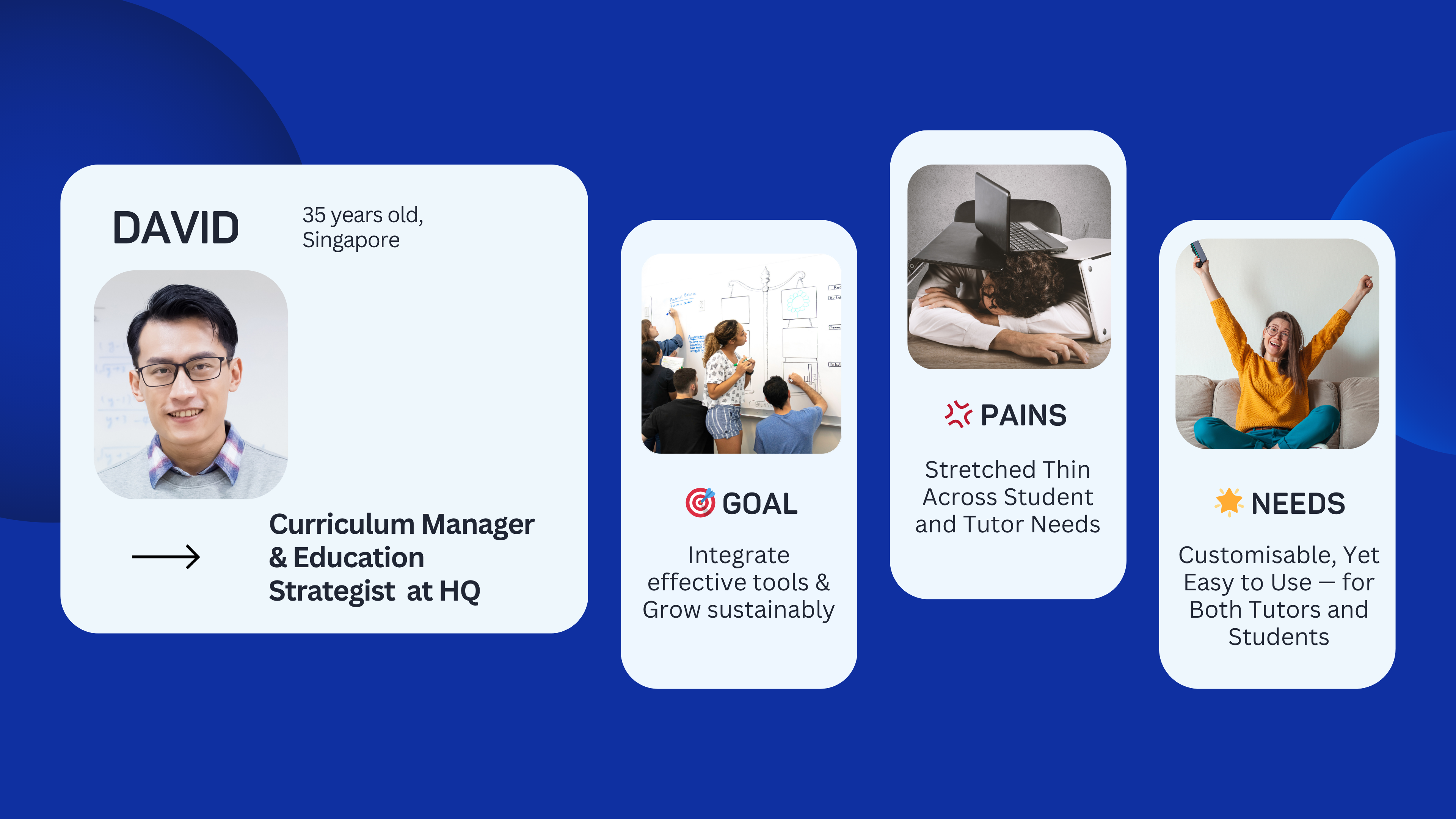
After conducting interviews with key B2B customers, we identified two distinct customer segments: individual tutors managing their own small businesses, and well-established learning centres operating multiple branches. From these insights, we developed two representative personas — Evelyn and David — to capture their unique goals, challenges, and solution needs. Evelyn represents independent tutors who juggle teaching and business operations, focusing on student engagement and business growth. In contrast, David represents curriculum leads at larger centres, where the focus is on scaling educational impact, ensuring tutor satisfaction, and integrating efficient, customisable edtech solutions. The following videos introduce these two archetypes and the key opportunities for addressing their distinct needs.
✏️ Mapping the Customer Experience: From Problem to Solution
What follows is a customer journey map — a tool used to visualise how users interact with a product or service over time.
It reveals key touchpoints, pain points, emotions, and decision-making moments — all from the user’s perspective.
In this case, the map highlights opportunities for Learning Platform H to better support its customers, helping them stay engaged and successful over the long term.
To explore more targeted business opportunities, we follow the journey of David — a curriculum manager and education strategist at the headquarters of a growing tuition centre.
David is responsible for identifying and implementing solutions that enhance teaching efficiency, boost student outcomes, and support tutor satisfaction across multiple branches.
Let’s walk through his experience — from recognising the problem to launching a new digital solution — in the video below.

 Min Hye-Yoon, 민혜윤